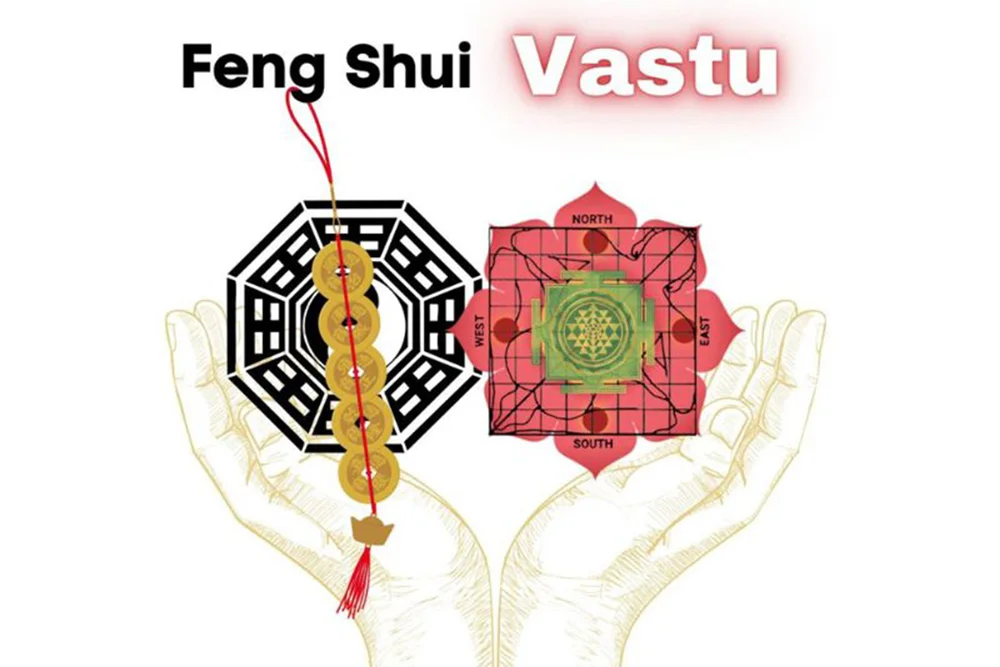

WHY FENG SHUI BECAME GLOBAL WHILE VASTU REMAINED REGIONAL

Feng Shui

Understanding visibility, not superiority.

We live in turbulent times. As interest in conscious living grows worldwide, many
people encounter Feng Shui long before they hear of Vastu Shastra. This is
because of how each tradition has travelled through history.

Why Feng Shui became GLOBALLY VISIBLE.

Very early on Feng Shui spread beyond China into East Asia. In the 19th and 20th
centuries, it entered Western awareness through Chinese diaspora. Later many
popular lifestyle books such as Living Earth Manual of Feng
Shui (1976) by Stephen Skinner cemented its popularity.

Another reason was that Feng Shui adapted well to modern urban life. It could be
applied inside existing homes. Furniture could be moved. Layouts adjusted.
Colours changed. Objects placed. This “plug-and-play” approach helped it gain
lasting visibility across media and popular culture.

Why Vastu remained LESS VISIBLE globally

Vastu Shastra developed as a complete architectural science in India. Its principles
are embedded in the geometry and orientation of the built form itself : land
selection, room placement, proportion, shape, balanced centre, elemental zoning,
and alignment with local geography and climate. Historically, Vastu travelled
through builders, temple architects, and lineage transmission in Sanskrit language
rather than mass publishing or lifestyle markets.

However, what impacted it the most was its historical disruption. From the
medieval period onwards the Persian Islamic architectural traditions gradually
displaced indigenous planning sciences such as Vastu, from state patronage and
institutional teaching. This was followed by 200 years of colonization by the
British. So, by the time India regained independence in 1947 it faced acute
poverty and widespread institutional breakdown. Traditional systems of learning
had been severely fragmented, deprioritised and displaced. As a result,
disciplines such as Vastu also missed evolutionary cycles that Feng Shui enjoyed
through its freedom and exposure to new lands and cultures. The present revival
of Vastu is, in this sense, a renaissance after nearly 600 years of disruption.

Do Feng Shui and Vastu do the same thing ?

They overlap in intention, but not in structure. Feng Shui works primarily with flow
and landform dynamics within existing spaces. Vastu governs the geometry and
directional coherence of the built form itself. One finetunes the environment. The
other shapes the structure that produces the environment. One mitigates
symptoms. The other addresses root design logic.

Both are the result of long term civilisational observation of how built
environments shape human stability and success. Feng Shui functions as a living
spatial tradition across many cultures. Vastu offers an architectural lens that
operates at the level of form, proportion, and directional order.

They are not competitors.
They just work at different layers of how space supports life.

FAQs

Q1. Why is Feng Shui more popular than Vastu Shastra globally?

Answer : Feng Shui spread early into East Asia and later the West through diaspora and lifestyle books. Vastu remained rooted in traditional architectural lineages and was not marketed globally.

Q2. Is Feng Shui more effective than Vastu?

Answer : No. Feng Shui adjusts flow within existing spaces. Vastu governs the design and orientation of the structure itself. They work at different levels.

Q3. Can Feng Shui and Vastu be used together?

Answer : Yes. Feng Shui fine tunes interiors, while Vastu guides structural and directional alignment. They can complement each other.

Q4. Why did Vastu not become global like Feng Shui?

Answer : Historical disruption and loss of institutions in India limited global reach, of Vastu unlike Feng Shui’s continuous cultural spread.