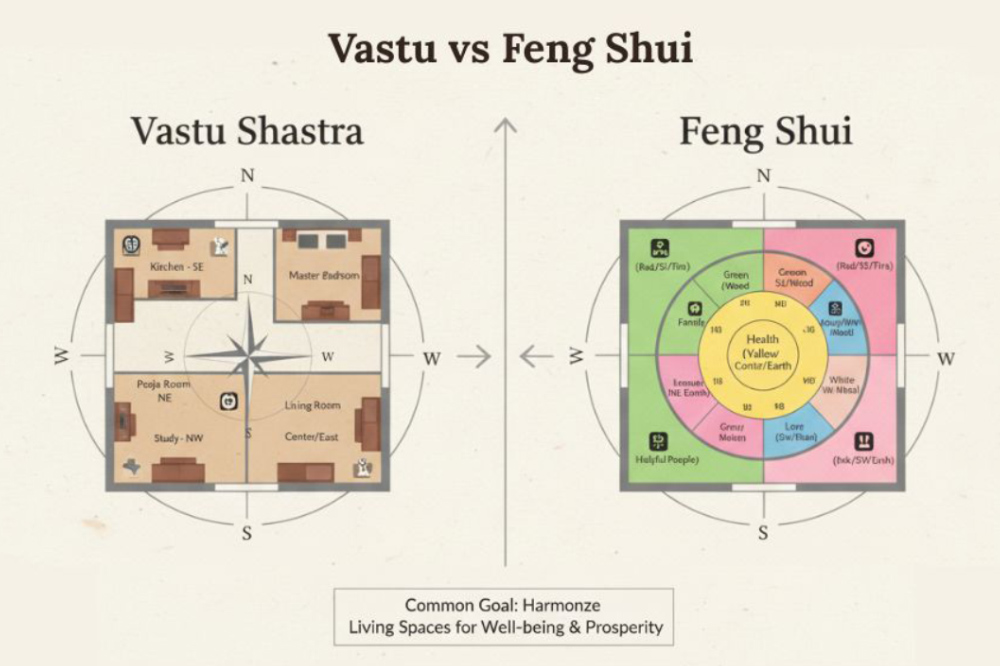
Vastu vs Feng Shui Explained: Origins, Principles and Practical Differences

Vastu vs Feng Shui

Choosing between Vastu vs Feng Shui is one of the most common dilemmas faced by homeowners and business owners today. Whether you live in a Singapore HDB flat, a condominium, a landed property, or manage a commercial space, the desire is the same a harmonious environment that supports health, wealth, and peace of mind.

In Singapore’s multicultural landscape, both Vastu Shastra and Feng Shui are widely discussed and often misunderstood. Many people wonder whether they are similar, interchangeable, or whether one is better suited for modern urban living.

This article serves as a clear, practical, and unbiased guide explaining the difference between Vastu and Feng Shui, their origins, principles, and real-world application, especially for Singapore homes and offices. By the end, you will be able to make an informed decision and understand why many people today prefer Vastu for long-term abundance and stability.

Origins of Vastu Shastra

Vastu Shastra is an ancient Indian science of architecture and spatial harmony that dates back over 5,000 years. Rooted in the Vedas, it is based on the belief that human dwellings should align with the laws of nature and cosmic energies.

Unlike decorative systems, Vastu is a spiritual science of space that integrates:

Ancient Indian sages developed Vastu by observing how natural forces influence human life, health, and prosperity. The orientation of land, placement of rooms, and flow of energy were carefully mapped to support wellbeing and abundance.

Vastu’s foundation is both scientific and spiritual, making it relevant even in today’s modern homes and urban environments like Singapore.

Origins of Feng Shui

Feng Shui originated in ancient China over 3,000 years ago and focuses on the flow of Chi (life force energy) within a space. The literal meaning of Feng Shui is wind and water, symbolising movement and nourishment.

Its core philosophy is built around:

Feng Shui evolved primarily as a method to enhance energy flow through placement, symbolism, and visual balance. Over time, it became popular for its accessibility and ease of application, especially in interior design.

While Feng Shui offers valuable insights into energetic balance, it is generally more decorative and corrective in nature compared to the structural depth of Vastu Shastra.

Core Principles of Vastu Shastra

Vastu operates on the principle that every direction carries a specific type of energy. Aligning activities and spaces with these energies leads to harmony and success.

Key principles include:

This makes Vastu highly suitable for modern homes, including Singapore HDB flats and condos, where structural changes are limited.

Core Principles of Feng Shui

Feng Shui focuses on balancing visible and invisible energies through conscious placement and symbolism.

Its main principles include:

Feng Shui works best as a short-term or supportive system, enhancing aesthetics and emotional comfort rather than structural energy alignment.

Practical Differences Between Vastu and Feng Shui

Understanding the difference between Vastu and Feng Shui becomes clearer when applied practically:

For those seeking deep rooted and lasting change, especially in property and business matters, Vastu Shastra often proves more effective.

Which Is Better for Modern Homes in Singapore?

Singapore presents unique challenges:

Vastu adapts exceptionally well to these conditions because:

Whether it is Vastu for home Singapore, offices, or retail spaces, a skilled Vastu Consultant in Singapore can provide precise solutions tailored to modern living.

Feng Shui, while popular, often remains surface-level when deeper energy imbalances exist.

Vastu vs Feng Shui for Wealth, Career & Peace

When people compare feng shui vs vastu for modern homes, the real question is results.

Abundance and Financial Flow

Vastu focuses on activating wealth zones through direction, structure, and elemental balance, supporting sustained financial growth.

Mental Clarity and Emotional Balance

Balanced energy layouts reduce stress, improve sleep, and enhance emotional stability.

Business Growth and Stability

Business owners often find Vastu more effective for:

Feng Shui can complement ambience, but Vastu works at the root energy level.

Can Vastu and Feng Shui Be Used Together?

Yes, but with caution.

Many people unknowingly create conflicts by mixing both systems without understanding their principles. Common mistakes include:

Expert guidance ensures both systems, if used together, remain aligned. In most cases, Vastu should form the foundation, with Feng Shui elements added selectively.

Online Vastu Consultation – A Modern Solution

With global connectivity, online Vastu consultation has become highly effective and accurate.

How it works:

Benefits for Singapore and worldwide clients include:

This makes it ideal for NRIs, overseas investors, and busy professionals.

Why Choose Vastu for Abundance

Vastu is not about superstition it is about alignment with natural laws.

At Vastu for Abundance, the focus is on:

With years of global experience, the approach blends traditional wisdom with modern practicality, making it suitable for today’s fast-paced lifestyle.

Frequently Asked Questions

Q1. Is Vastu better than Feng Shui?

Answer: Vastu works at a deeper structural and directional level, making it more suitable for long-term results, while Feng Shui offers supportive enhancements.

Q2. Does Vastu work in Singapore homes?

Answer: Yes. Vastu works effectively in HDB flats, condos, and landed homes when applied correctly.

Q3. Can Vastu be applied without renovation?

Answer: Absolutely. Most vastu doshas can be corrected without demolition using precise remedies.

Q4. How accurate is online Vastu consultation?

Answer: When done professionally, online Vastu consultation is highly accurate and widely used globally.

Q5. Is Feng Shui enough for wealth problems?

Answer: Feng Shui may provide temporary relief, but persistent financial issues often require deeper Vastu correction.

Q6. Do I need a Vastu Consultant in Singapore?

Answer: Yes, working with an experienced consultant ensures accurate analysis tailored to local conditions.

Conclusion

The debate of Vastu Shastra vs Feng Shui ultimately comes down to depth versus decoration. While both systems aim to create harmony, Vastu offers a structured, scientific, and spiritually grounded approach that delivers lasting transformation.

For Singapore homeowners, professionals, and global clients seeking clarity, stability, and abundance, Vastu provides a reliable path forward.

If you are at the decision making stage and want personalised guidance, consider consulting a trusted Vastu Consultant in Singapore who understands both traditional wisdom and modern living.

An aligned space creates an aligned life and abundance naturally follows.