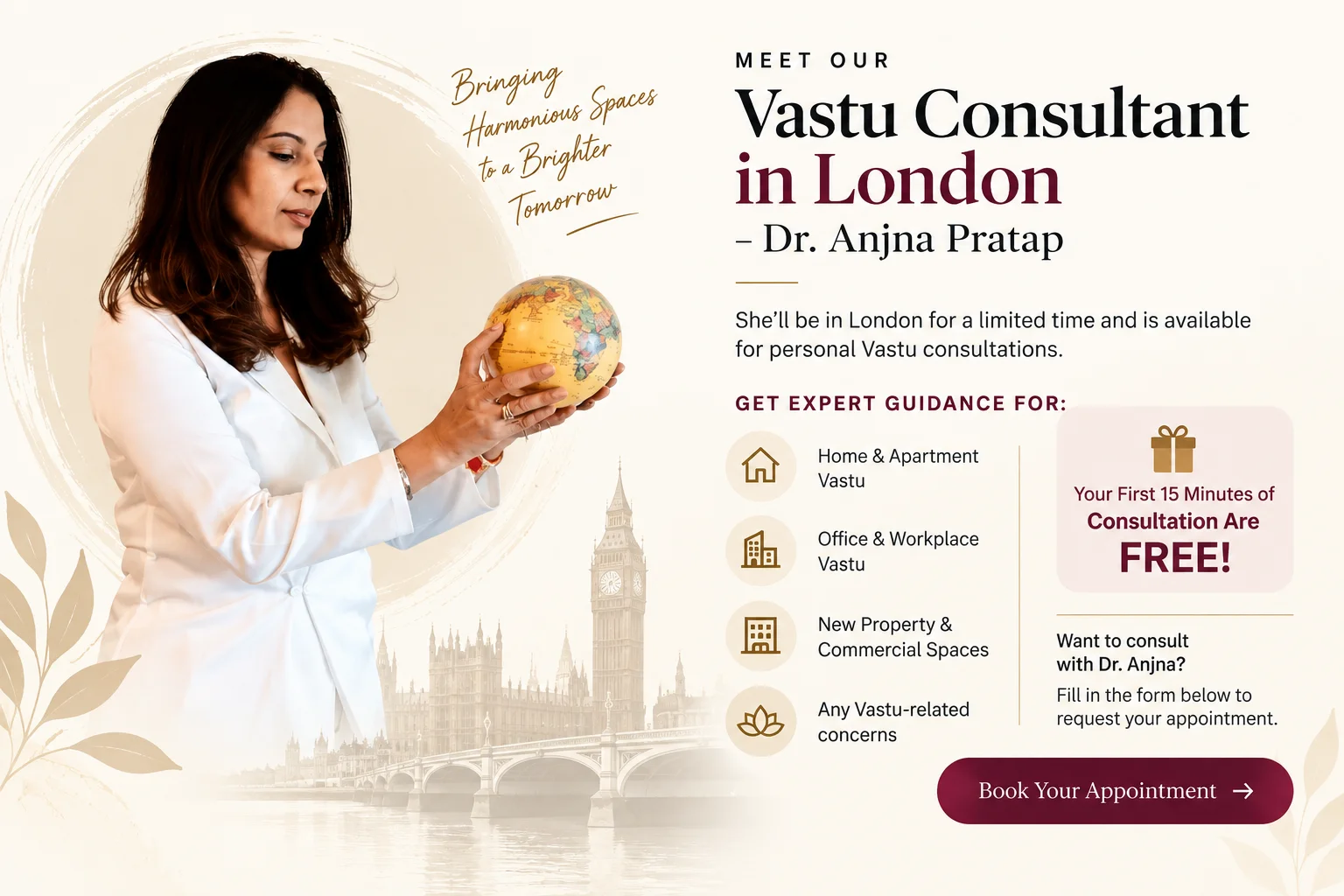

Vastu Consultant in London - Dr. Anjna Pratap

Wembley Park: Vastu for a New Way of Life

Wembley Park Vastu for a New Way of Life

What happens when a place known for people arriving for a day begins asking them to stay?

Wembley takes its name from “Wemba lea”, meaning Wemba’s clearing, recorded in 825. Over the centuries, woodland and farmland gave way to a growing suburb, its development accelerated by the railway and the British Empire Exhibition of 1924 and 1925.

Within this changing landscape, Wembley Park developed a character of its own as a place of leisure. Its pleasure grounds opened in 1894, drawing Londoners to its gardens and entertainment for a day out.

The original Wembley Stadium, which opened in 1923, and the exhibition pavilions that followed brought the world to Wembley Park. From Event Ground to Neighbourhood

Arrival • movement • residence

In 2002, Quintain acquired approximately 44 acres of exhibition land and car parks around the stadium, later expanding its estate to 85 acres.This was the land being reimagined: an event district within an already established residential Wembley.

By September 2025, Quintain had delivered 6,000 homes across different tenures, alongside shops, restaurants, cultural spaces and Union Park’s seven acres of public green space. A landscape organised around occasional crowds was acquiring the infrastructure of everyday life.

The architectural transformation is visible immediately.The change in how people live here is more revealing.Housing for a Mobile London

Mobility • flexibility • community

Quintain Living, established under the leadership of Rajesh Shah, launched as Tipi in 2016 and adopted its present name in 2020. It brought Build to Rent into the heart of Wembley Park’s residential model: professionally managed rental homes with shared facilities and services integrated into the development.

By June 2026, Quintain Living managed more than 3, homes at Wembley Park.

The model speaks to a familiar experience of contemporary London. An international student arrives for education and stays for work. A professional moves from Singapore or Dubai to London, uncertain where the next opportunity will lead. A couple wants a home together before deciding where to settle.

For such residents, a well maintained apartment complex such as Ferrum at 40 South Way, with gardens, lounges and workspaces can make arriving in a new city easier. A sense of home can begin before a decision about permanence.Mobility itself has become something housing has to accommodate.Renting can also become a lasting choice. Families and older residents belong to these communities too; flexibility need not mean a short stay.

The wider neighbourhood matters as much as the apartment. For people arriving in search of opportunities, its accessibility, orientation and openness deserve attention. This is where I begin my reading through Vastu.

The Vastu of Arrival and Movement

North • opportunities • growth

With Wembley Park Underground station to the North and Wembley Stadium railway station on the southern side, connectivity is firmly established at both ends of the neighbourhood. Olympic Way, opened for the 1948 Olympic Games, has long carried crowds from Wembley Park station towards the stadium’s North Entrance.

Standing on Olympic Way, I am struck by the broad, open approach to the stadium.In Vastu, North is associated with abundance, opportunities and growth. The stadium’s open northern approach is therefore a favourable feature in my reading, particularly resonant in a neighbourhood welcoming people in search of education, careers and new possibilities.

Slope to the North and Vastu

At the Boxpark site beside Olympic Way, the land slopes from South to North, as recorded in Brent’s planning report. This local topography corresponds with Vastu’s traditional preference for higher ground in the South and lower ground in the North.

Several of Quintain’s residential buildings also appear closely aligned with the cardinal directions. Their regular, clearly defined forms avoid the awkward cuts and projections considered unfavourable in Vastu.

Natural Light

The large windows in Quintain’s residential buildings make the most of available daylight, particularly valuable during the UK’s shorter winter days. They make the homes feel brighter and more inviting, while supporting the openness and positive energy valued in Vastu, especially when facing North and East.

Dining and Exchange

Although restaurants and cafés are scattered throughout the development, prominent clusters are found towards its West and North West. In Vastu, the West is considered favourable for dining, while the North West is associated with Vayu, the air element, and with movement and exchange.

Continuity

Despite its new residential model and modern skyline, Wembley Park retains something of its earlier character. For generations, Wembley Park has attracted people through its pleasure grounds, exhibitions, football and concerts. Spectators arrive, experience the excitement of an occasion and depart.

Now another kind of movement takes place alongside them. Rental residents arrive from different cities and countries, settle for a few years or perhaps much longer, and move as their lives and opportunities evolve. The enjoyment once offered for a day out is now woven into everyday life through gardens and shared spaces. It is almost as though Wembley Park’s longstanding energy of movement and arrival is finding a new expression in residential life.

The Perspective of Time

From new development to established neighbourhood. Older suburban Wembley and the new neighbourhood beside the stadium now sit alongside one another, expressing different periods of London’s growth.

My previous blog on Regent’s Park offers an important perspective. Its terraces and parkland, now inseparable from historic London, were once an ambitious new development. As its landscape matured and generations made their homes there, the development became part of London’s familiar fabric.

Wembley Park belongs to another period, shaped by international mobility and a different residential model. Its future character will emerge from how people inhabit the buildings and spaces now being created.

For me, this is where the changing face of London becomes most interesting to read through Vastu: in the relationship between a place’s physical form, its inherited character and the lives unfolding within it.

A place once designed for gathering is learning how to become home.