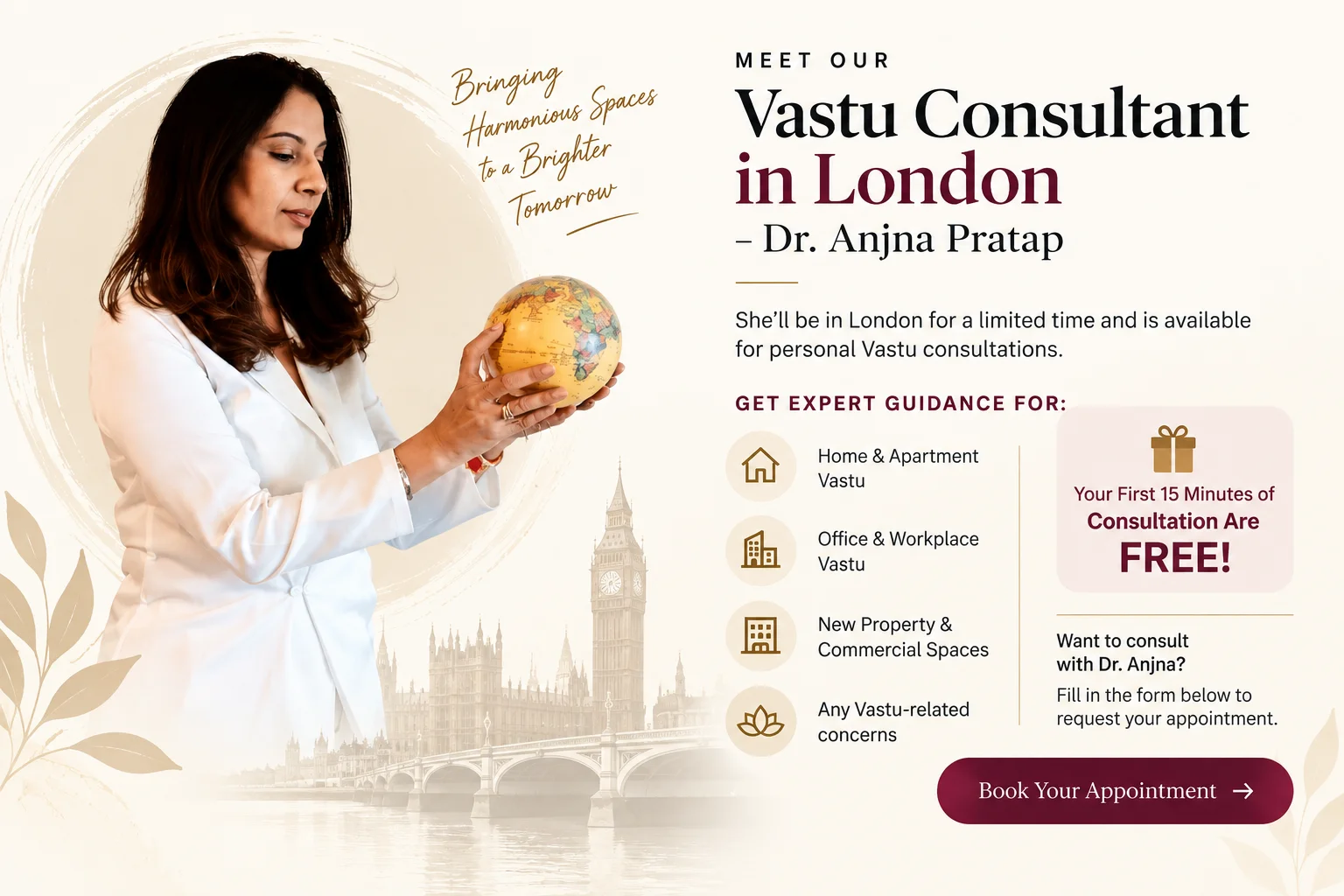

Vastu Consultant in London - Dr. Anjna Pratap

Regent’s Park Through the Lens of Vastu

Regent’s Park Through the Lens of Vastu

What happens when we look at one of London’s most celebrated historic landscapes through the lens of Vastu?

Nash’s Grand Vision

Architecture • landscape • ambition

Regent’s Park is particularly fascinating because its architect and planner, John Nash, envisioned it as far more than a park. His plan brought together villas, terraces, roads, water and gardens into one grand design.

It was extraordinarily ambitious for its time: around 56 villas, majestic terraces around the park’s perimeter, a palace for the Prince Regent, a grand central circus of houses, and even a canal running through the park.

Much of it, however, was never realised. Only eight villas were built, the palace and Great Circus disappeared from the final scheme, and the Regent’s Canal was eventually rerouted around the northern side of the park.

What emerged was considerably lighter and more open than Nash had originally imagined. Ironically, that openness became one of Regent’s Park’s greatest strengths. And perhaps that is where the Vastu story really begins.

The Land Comes First

Slope • Earth • directional balance

In Vastu, before I look at the architecture, I first look at the land. Regent’s Park has a gentle slope towards the South.

Classical Vastu texts take the direction of slope very seriously. The Viśvakarmaprakāśa describes the effects of all eight directions:

पूर्वप्लवे भवेलक्ष्मीराग्नेय्यां शोकमादिशेत् । याम्यां याति यमद्वारं नैर्ऋते च महाभयम् ॥
पश्चिमे कलहं कुर्याद्वायव्यां मृत्युमादिशेत् । उत्तरे वंशवृद्धिः स्यादीशाने रत्नसञ्चयः ॥

An eastern slope is associated with prosperity, the North with growth of lineage, and the North East with accumulation of wealth and wisdom. In contrast, slopes to the West lead to conflict, while the South and South West create obstruction, loss, delay or even the “death” of plans and aspirations.

At Regent’s Park, the southward slope reverses the preferred directional balance of the land and weakens the Earth element, which is meant to be strongest in the South and South West directions as per Vastu.

To me, this is the park’s principal Vastu imbalance.

The Terraces vs the Slope

Mass • stability • containment

York, Hanover, Chester and Cumberland Terraces are among the park’s most recognisable architectural features. Their long, imposing façades give its perimeter much weight and solidity.

But what interests me through Vastu is not simply their majestic beauty. It is the direction in which that architectural mass is located: West, South West and South, precisely where Vastu prefers greater weight, height and stability.

I am not claiming that the terraces succeeded in altering the negative effect of the slope, yet their presence seems to provide an almost intuitive counterweight.

Regent’s Park Terraces: do directions matter?

Cumberland Terrace in the East has long had a visible public profile for its well known residents and frequent media attention. It seems strangely fitting for the eastern energy of visibility, social connection and outward engagement as per Vastu.

I was also not surprised to learn that it was the eastern side of Regent’s Park that first opened to the public in 1835.

York Terrace West tells a different story. It sits along the southern periphery and today has a much quieter, more private residential character. In my Vastu reading, the South carries a more settled energy of rest, comfort and relaxation. The contrast between the two terraces is subtle but fascinating: one seems to look outward; the other feels more settled within.

The Boating Lake : lake in South West

Water • Earth • anchoring

The Boating Lake lies across much of the South West, where Vastu prefers stability, weight and the Earth element. A deep water body here is therefore considered highly unfavourable.

Records tell us that the lake was originally excavated to a depth of 4 metres, but after the 1867 skating tragedy, when 40 people drowned, the lake was made much shallower, reducing its depth to around 1.2 to 1.5 metres.

From a Vastu perspective, this was a fortunate change because it restored some of the Earth element and weight lost from the South West.

Its branching Y shape also spreads the water rather than concentrating it in one deep area. This may have helped reduce the vastu imbalance.

The Regent’s Canal : water along the northern periphery

Water • movement • openness

Rather than cutting through the centre of the park as Nash originally intended, the Regent’s Canal  was rerouted around much of the northern perimeter. Classical Vastu gives great importance to the presence of water in the North and North East, associating these directions with growth and prosperity.

The Northern side has a very small architectural footprint.. Even London Zoo, which occupies a large part of the North is spatially very different from a continuous wall of large buildings.

Thus the  canal and lighter north, balance the much heavier southern side. Together they create  a clear contrast between water and built mass, openness and enclosure.

From the Great Circus to Queen Mary’s Gardens

Roses • visibility • recognition

Nash had imagined a monumental Great Circus of houses here. Had it been realised, it would have introduced considerable built height and weight into the central field.

 It was never built.

From a Vastu perspective, that omission is especially significant. The Brahmasthan, or central field, is ideally kept open and free from excessive structural weight, allowing light, space and movement through the heart of the site.

The Inner Circle, towards the South, eventually evolved into Queen Mary’s Gardens, where 8,000 roses bloom today. In Vastu, this area falls within the energy field of visibility, recognition and fame. It may be sheer coincidence, but a rose garden here is considered a powerful Vastu remedy for strengthening these very qualities.

The Enduring Appeal of Regent’s Park

The Hand of Time and Fate Nash could never have foreseen the Regent’s Park we know today. Financial pressures, circumstance and later decisions all shaped his legacy.

Seen through Vastu, its enduring appeal may lie in the balance that emerged. While the land still sloped to the South, the Brahmasthan stayed open, the North remained light with flowing water, and the South and South West carried anchoring weight. The Boating Lake stayed, but the South West almost magically regained much of its lost Earth element, while 8,000 roses came to bloom in a Vastu energy field of visibility and fame.

I would never suggest that Vastu caused these historical events. But through the lens of Vastu, the way they eventually came together is fascinating.