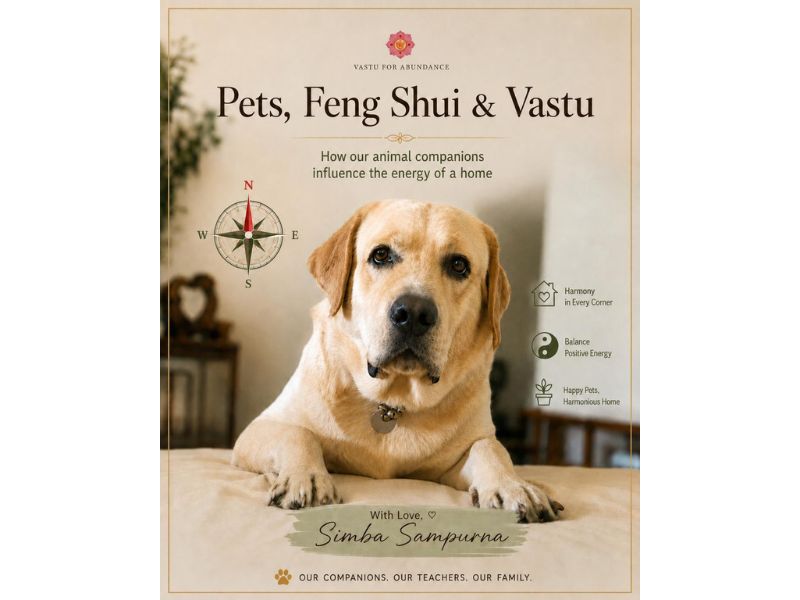

Can Your Pet Improve Your Home Energy? Some Myths, Facts, and Practical Tips: Feng Shui / Vastu

Feng Shui for pets

A home can be beautifully designed and still feel strangely lifeless. Another may be far less perfect, yet feel warm and welcoming the moment you enter.

Why? Because we do not experience a home only through furniture and colour. We experience movement, sound, light, relationships and the life taking place within it.

Pets are very much part of that life.

In Feng Shui, this living force is understood through Qi. A dog running to greet you, a cat choosing the same sunny corner every afternoon, or fish moving gently through water can change the atmosphere of a room immediately.

This is why Feng Shui for pets is worth understanding properly, without reducing it to superstition.

A Pet Is Not a Feng Shui Remedy

Simply owning a particular animal does not guarantee luck.

A neglected aquarium does not become auspicious because fish symbolise prosperity. An anxious dog living in an unsuitable environment does not automatically create good Qi.

Good Feng Shui for positive energy starts with the quality of the environment and the life occurring within it.

Vastu approaches the subject differently, but classical texts also show sensitivity towards nature and living creatures. The Bṛhat Saṃhitā, for example, advises against cutting trees inhabited by birds:

खगनिलयभग्नसंशुष्कदग्धदेवालयश्मशानस्थान् क्षीरतरुधविभीतकनिम्बारणि वर्जितान्छिन्द्यात् ५३.११८

Bṛhat Saṃhitā, Vāstu Vidyā, 53.118

The verse is about timber selection, not pets, but it shows that the classical Vastu landscape was not viewed as lifeless architecture. The surrounding ecology mattered.

Where Should Pets Be Kept?

Generic rules do not work well because different animals interact with a home differently.

I do not recommend keeping pets permanently in the North East. This is traditionally a quieter zone connected with clarity, prayer and meditation. In my experience, continuously housing animals here can disturb the quality of this space and may not be supportive for the animal either.

I  discourage people from keeping their pets in Fire zones such as South East or negative zones such as West of North West and also South South West.

Cats and dogs should not automatically be treated in the same way. Cats, in particular, are fascinating because they often select their own favourite areas.

Watch where your cat repeatedly sits. Which corner does it return to? Where does it sleep comfortably? Which areas does it avoid?

Animals can sometimes tell us a surprising amount about the warmth, light, activity and overall feel of different spaces.

Larger animals require a different approach. Horses and other large animals should ideally have their own properly designed shelter or separate area rather than being treated as an extension of the human living space. I have discussed this subject separately in my LinkedIn post.

Do Pets Bring Positive Energy?

A healthy, happy pet can certainly contribute to the positive feeling of a home.

Dogs introduce movement and routine. Cats draw our attention to warmth, sunlight and quiet areas. Birds bring sound and animation. Fish introduce the visual movement of water.

But cleanliness matters.

Pet beds should have defined positions rather than blocking circulation. Feeding areas should remain clean, and toys, cages, food bags and leads should not overwhelm an entrance or important living area.

Sometimes what gets blamed on the pet is really poor organisation around the pet.

What About Fish Tanks and Koi Ponds?

This is where Feng Shui and Vastu must be distinguished carefully. Vastu prefers to place any fish tank  in the zone of anxiety and churning to quieten the mind that is not at rest.

However  in Feng Shui, the North is one of the commonly recommended areas for a fish tank because it is associated with the Water element and career opportunities. The Southeast is also traditionally favoured for wealth and abundance, while the East may be used to support family and growth.

A koi pond requires even greater care.

When assessing an external pond, its direction should be determined while standing inside the house and looking out towards it. This is something I frequently see assessed incorrectly.

In my consulting experience, I have seen koi ponds placed in unsuitable directions in homes where there were also serious disturbances between married couples.

Water is powerful. Its placement deserves proper analysis.

Pets and Vastu for Abundance

If you are exploring Vastu for Abundance, do not begin by searching for a lucky pet.

Abundance is larger than symbolism. A supportive home encourages clarity, movement, stability, connection and the ability to receive and retain opportunities.

A pet can add enormous warmth and vitality to such a home.

The better question is:

Is my pet living in a part of the house that genuinely supports both the animal and the energy of the home?

That distinction matters far more.

FAQs

Q1. Are pets good for Feng Shui or Vastu?

Answer: Yes. Healthy and properly cared for pets can introduce movement, warmth and vitality.

Q2. Which pet is considered lucky in Feng Shui/Vastu?

Answer: Fish are associated with prosperity and dogs with loyalty, but no animal guarantees luck.

Q3. Do dogs bring positive energy into the home?

Answer: Their movement, companionship and routine can contribute to a lively atmosphere.

Q4. Where should a fish tank be placed according to Feng Shui?

Answer: Many Feng Shui practitioners favour the North, but placement should always be assessed for the individual property.

Q5. Do pets affect the energy of a house?

Answer: Yes. They influence movement, sound, routines and the emotional atmosphere of a space.