
Vastu Consultant in London - Dr. Anjna Pratap

Vastu and Self Sabotage: Is Your Home Programming You to Fail?

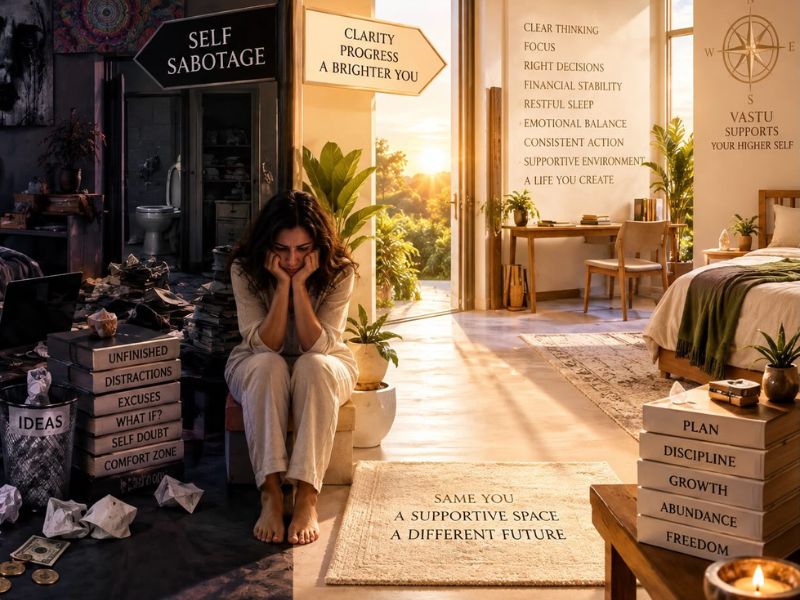
Vastu and Self Sabotage Is Your Home Programming You to Fail

Self sabotage is usually blamed on mindset: procrastination, poor discipline, fear of success or an inability to follow through. In my work as an Astro Vastu consultant, I know the person and the space cannot be examined separately.

A misplaced entrance, unstable slope, excessive openness where the house needs weight, water or fire in an unsuitable zone, or a dark and blocked part of the home can disturb its balance. Over time, such conditions may make it harder to stay focused, make clear decisions, retain money or feel settled.

This is where Vastu and self sabotage intersect. Vastu does not say that a house controls your destiny. It asks a simpler question: does your environment support your progress, or make that progress harder?

Vastu Was Always About Wellbeing

The Viśvakarma Prakāśa states:

“Vāstuśāstraṃ pravakṣyāmi lokānāṃ hitakāmyayā.”

“I shall expound Vastu Shastra for the welfare of the people.”

Viśvakarma Prakāśa, Chapter 1, Verse 5.

The purpose is clear. Vastu is not only concerned with how a building is constructed. It is concerned with how well people are able to live within it.

The Samarāṅgaṇa Sūtradhāra, in its chapter on Gṛhadoṣa, examines defects connected with land, entrances, levels and construction. The Aparājitapṛcchā, Sūtras 51 and 52, similarly discusses the directional slope of land under Plavavicāra.

These texts repeatedly return to the same principle: the condition of the space affects the quality of life within it.

When a House Cannot Hold

One of the most overlooked principles in Vastu is weight.

The South West carries the quality of Prithvi, the earth element. It represents stability, containment and the ability to hold. This part of the home should therefore feel comparatively solid, protected and grounded.

When the South West is cut, depressed, excessively open, weakened by large windows or occupied by substantial water, the house loses some of that stability. In practice, this is the kind of imbalance I examine when people struggle to retain money, stay with decisions, complete long term plans or feel secure in what they have built.

For Vastu for wealth and prosperity, receiving opportunities is only part of the picture. The ability to retain and build upon what comes to you is equally important.

Light, Windows and Mental Rhythm

The opposite principle applies towards the North, North East and East, where greater openness and daylight are traditionally encouraged.

The Mānasāra, Chapter 33, Verses 595 and 596, says that windows should be opened in suitable places because they provide beauty, comfort and convenience.

There is also a practical reason for this. Eastern openings bring light into the home early in the day, when the body is naturally moving from rest into activity. Morning light helps regulate circadian rhythm, alertness and sleep timing.

A home that stays dark through the morning but receives most of its strongest direct light later in the day creates a different pattern. This does not mean western light is harmful. It means the home may receive less useful morning light and more intense light and heat later in the day, when the body should gradually begin to slow down.

If sleep and daily rhythm are repeatedly disturbed, focus, discipline and follow through become harder. This is where Vastu for mental peace connects directly with everyday behaviour.

What Are You Repeating Visually?

Architecture is not the only influence in a home. What you see repeatedly also matters.

Paintings of grief, loneliness, conflict or distressed figures, photographs connected with painful periods, or sculptures that suggest agitation or intense struggle can keep returning the mind to the same emotional themes.

The opposite extreme can also disturb clarity. Too many psychedelic patterns, optical designs, clashing images or visually busy surfaces can make a room feel restless and mentally tiring.

The question is simple: what feeling does your home keep reinforcing?

Calm? Stability? Possibility?

Or sadness, confusion and agitation?

Room function matters too. A toilet, heavy kitchen or cluttered storage area in a zone associated with clarity and contemplation works against the quality expected from that part of the home. In the same way, a bedroom placed in an overly active zone may make deep rest more difficult.

You may be asking your mind for clarity while surrounding it with conditions that continually reinforce the opposite.

The Entrance Sets the Tone

The Mānasāra, Chapter 38, Verses 15 to 17, identifies the Mahendra quarter for a principal eastern entrance, while Verses 20 and 21 identify Gṛhakṣata on the southern side.

This is why simply saying that a house has an East entrance or a South entrance is not enough. The exact pada matters.

When assessing Vastu for career growth, I look at the entrance carefully because it is the main point through which people, movement and opportunities enter the property.

Vastu Tips for Success

The best Vastu tips for success begin with the structure of the home, not with decorative cures.

Check the exact entrance position. Keep the South West stable, heavy and protected. Maintain suitable openness towards the North, North East and East. Examine slopes, pits, basements and large water bodies carefully. Check whether fire and water are placed appropriately. Reduce unnecessary visual noise. Remove imagery that repeatedly reinforces sadness, conflict or scarcity. Make sure the function of each room suits the quality of the zone it occupies.

Effective Vastu remedies begin with correcting the source of the imbalance, not just its visible effects.

Self Sabotage or Environmental Reinforcement?

A home cannot make somebody fail. But it can make certain states easier to repeat.

A stable house supports grounding. Morning light supports rhythm. A strong earth zone supports containment. Calm imagery reduces mental noise. Correct room functions reduce conflict within the space.

These are also qualities needed for success: clarity, consistency, stability and the ability to hold what you create.

So if the same pattern keeps repeating despite conscious effort, ask:

Does your home support the behaviour required for the life you are trying to build?

FAQs

Can your home environment cause self sabotaging behavior?

Answer: Not directly. But an imbalanced environment can make it harder to feel settled, focused and consistent, which may reinforce habits such as procrastination, indecision or poor follow through.

Q2. Can Vastu remedies improve financial growth?

Answer: Vastu for wealth and prosperity focuses on supporting stability, opportunity and retention. It should strengthen good financial decisions, not replace them.

Q3. How does clutter affect your mindset and productivity?

Answer: Clutter creates visual distraction and can leave the mind with a constant sense of unfinished activity. In Vastu, congestion can also weaken the intended quality of an important zone.

Q4. How can you improve positive energy at home?

Answer: Start with light, ventilation, a clear entrance, a stable South West and suitable openness towards the North, North East and East. Then assess fire, water, slopes, pits, room functions and the visual messages repeated throughout the home.